
What if your next trip to New York, Barcelona, or Dubai could be partly or fully covered by your business—legally?
For agency owners, travel is often a necessity, whether for meeting clients, attending industry events, or exploring new markets. But most business owners don’t realise they can structure their travel so it becomes a legitimate business expense—reducing their tax bill and keeping more money in their pocket.
If you’re still paying for business travel from your taxed personal income, you’re wasting money.
Here’s how to do it the right way.
When Can Your Business Pay for Your Travel?
HMRC allows businesses to deduct travel costs from taxable income if the trip is genuinely for business purposes. But get this wrong, and you could face trouble with HMRC.
To qualify as a business expense, the trip must meet three key rules:
- The primary purpose of the trip must be business-related. Personal holidays don’t count.
- Flights & hotels are tax-deductible if the travel is necessary for work. This includes client meetings, conferences, and networking events.
- If you extend the trip for personal reasons, you personally pay for the extra leisure days. Your business can’t cover personal expenses.
Translation: If you structure your trip properly, your business can legally pay for flights, some of your accommodation, meals, and local transport.
How to Structure Your Trip for Maximum Tax Deductions
Let’s break this down with an example.
The Barcelona Client Trip: Business + Leisure Done Right
Imagine you run an agency, and you have a client based in Barcelona. You’re planning to visit them but also want to spend a weekend exploring the city.
Here’s what you’re allowed to do:
📅Friday: Meet with a client for a strategy session → Flights & hotel are tax-deductible
📅Saturday-Sunday: Stay in Barcelona for personal leisure → You cover these costs personally
📅Monday: Attend a digital marketing conference → More tax-deductible days
This setup can mean you go away on a business trip, but still enjoy some downtime.

What Travel Expenses Can Your Business Cover?
Once you've confirmed the trip qualifies as a business expense, here’s what your agency can pay for legally:
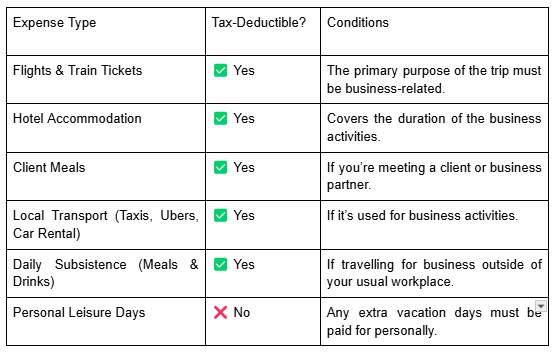
How to Prove Your Trip Is Business-Related
HMRC can challenge travel expenses if they think you’re trying to claim a holiday as a business trip. To stay compliant, always keep records of the business activities during your trip.
How to Keep Proof for HMRC:
- Meeting confirmations – Emails with clients confirming your appointment.
- Conference tickets & schedules – Proof that you attended an event.
- Receipts for business-related expenses – Hotels, meals, taxis, etc.
- Calendar screenshots – Showing planned business meetings or events.
Having clear documentation ensures that if HMRC ever audits your travel expenses, you have the proof to show the trip was business-related.
Common Mistakes That Could Get You in Trouble
- Trying to claim an entire holiday as a business trip.
- If there’s no real business justification, HMRC won’t allow the deduction.
- Not keeping records.
- If you can’t prove meetings or work-related activities, you could face a tax bill later.
- Mixing personal and business expenses.
- Make sure your personal costs (extra leisure days, personal meals) are kept separate from business expenses.
Let Your Business Pay for Your Travel
If you travel for work, there’s no reason to pay for it out of your taxed personal income. When structured correctly, your business can legally cover:
- Flights & hotels for business-related travel
- Meals & transport when meeting clients
- Conferences, industry events, and networking trips
The key is to plan it right, keep records, and only claim what’s legitimately business-related.
If you want to optimise your travel expenses and save more on tax, Sidekick Accounting can help.
Get in touch to make sure your next trip is structured for maximum savings
Questions agency owners ask
How can I make my business travel tax-deductible?
To make your business travel tax-deductible, ensure the trip is genuinely for business purposes. The primary purpose must be business-related, such as client meetings or conferences. If you extend the trip for personal reasons, you must cover those extra costs yourself.
What travel expenses can my business cover?
Your business can cover expenses like flights, hotels, meals, and local transport if the trip qualifies as a business expense. Additionally, if you attend a conference, the ticket itself is also tax-deductible.
What records do I need to keep for HMRC?
To prove your trip is business-related, keep records such as meeting confirmations, conference tickets, receipts for business-related expenses, and calendar screenshots showing planned meetings. This documentation is essential if HMRC audits your travel expenses.
What are common mistakes to avoid when claiming travel expenses?
Common mistakes include trying to claim an entire holiday as a business trip without proper justification, not keeping records of business activities, and mixing personal and business expenses. It's important to keep personal costs separate from business expenses.
Can I claim personal leisure days as business expenses?
No, personal leisure days cannot be claimed as business expenses. If you extend your trip for personal reasons, you must pay for those extra days yourself.